How do i convert.wav files into Rex files? AndyL New member. Jul 2, 2004 #2 Recycle. Samplecraze Zukan. Jul 2, 2004 #3 Yep, rex is Recycle's extension. To convert a.resx file to a.resources file, you use the Resource File Generator (Resgen.exe), which has the following basic syntax: Resgen.exe.resxFilename. The result is a binary resource file that has the same root file name as the.resx file and a.resources file extension.
- Free File Converter To Pdf
- Free File Converter Online
- Free File Converter Download
- Mp3 To Rex File Converter



Free File Converter To Pdf
Tip - Searching Documentation
Tip: To search for a specific topic, type your search query in the Search Cakewalk.com field at the top right of this page.
When the search results appear, click which product's documentation you would like to search to filter the search results further.
Note - Using Offline Help
Note: If you prefer to always use offline Help, go to Edit > Preferences > File > Advanced in your Cakewalk software and select Always Use Offline Help.
If you are not connected to the internet, your Cakewalk software will default to showing offline help until an internet connection becomes available.
Slice your sampled loops with ReCycle and turn them from rigid recordings to flexible musical elements that blend seamlessly with your music. ReCycle slices loops into their rhythmical components, letting you quantize, rearrange or totally reimagine your sampled grooves.
ReCycle finds all the transients in your sampled material and slices your loop up, while also keeping the timing information so you can play it back at any tempo without losing its feel or with the artifacts that come from time stretch.
Sculpt your sound with ReCycle’s built-in effects: Transient Shaper, EQ, Envelope and a stretch feature that stretches the tail end of your each slice in the loop.
Save your loops as REX files and let the creative part begin. With ReCycled audio, your loops can be arranged, rearranged have their timing altered or even be used as a groove template for your song.
1. Like the sounds of your loop, but the feel isn’t right for your song? ReCycled loops can be quantized in your sequencer to fit with any groove.
2. Or maybe you feel of your loop, but the snare isn’t right? Simply replace the snare while keeping the tempo.
3. Create a more living performance by rearranging the loop’s slices in your sequencer to create fills and variations.
4. Use your sequencer’s groove quantize to set the ReCycled loop as your groove template and have the whole track swinging to your loop.
The REX file format
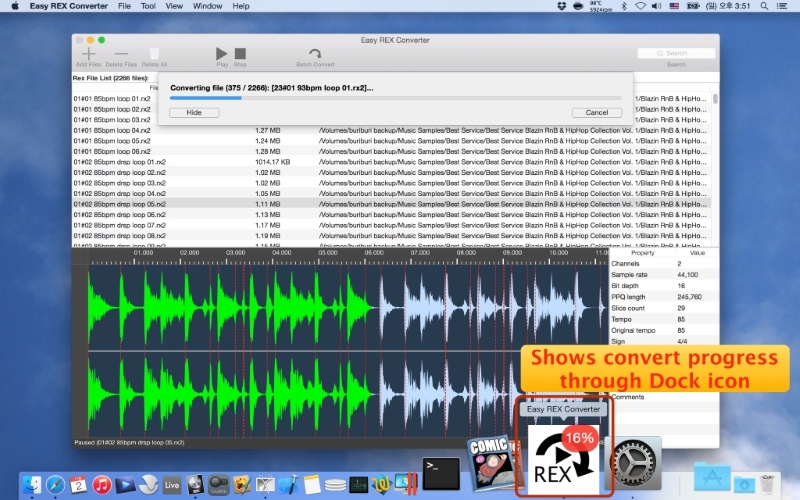
REX is the native file format of ReCycle. A REX file contains the original audio of the loop, the slices you have applied in ReCycle, and any effects or processing you have added in ReCycle. REX files are also compressed, using a non-lossy compression technique to save some precious hard drive space. The REX technology is available for third parties and has become the de facto standard for loop handing in just about every DAW.
Free File Converter Online
REX - the industry standard.
These are the apps that support the REX technology today:
- Ableton Live
- Steinberg Cubase
- MOTU Digital Performer
- Image-Line FL Studio
- Apple Logic
- Steinberg Nuendo
- Avid Pro Tools
- Cockos Reaper
- Reason Studios Reason
- Renoise
- Cakewalk Sonar
- Presonus Studio One
- Native Instruments Kontakt
- Native Instruments Maschine
- MOTU MachFive
- Steinberg HALion
- Spectrasonics Stylus RMX
- SonomaWireWorks RiffWorks
- SonomaWireWorks DrumCore
- Toontrack Beatstation
- Avid Transfuser
- fxpansion Geist
- …and more
Want to take ReCycle for a spin? Download the demo and try using ReCycle with your current music setup. Demo limitations: the demo version comes with four built-in loops that can be treated, but saving as REX files is disabled.
System Requirements (Mac)
- Intel processor (or better)
- 512 MB of RAM or more
- Mac OS X 10.5 or later
- 800×600 display (or better)
Free File Converter Download
System Requirements (Windows)
Mp3 To Rex File Converter
- PC with 300 MHz or faster Pentium compatible processor
- 512 MB of RAM or more
- Windows XP, Windows Vista, Windows 7 (or later)
- 800×600 display (or better)
- 16-bit Windows compatible audio card, preferably with an ASIO or DirectX driver